Brief Introduction to Serialism
- Abhishek Timbadia

- Jan 1, 2020
- 5 min read
Updated: Jun 19, 2021
In this blog I will be discussing a technique that composers from the 20th century have used. I will be talking about its brief origins, history and will dwell into how it can be used. I will mention a few pieces that utilize this technique and some of my personal compositions. I cannot guarantee it being an amazing one.
The musical composition technique is called serial music or the more popular name the “12-tone row” technique. This technique was invented by Arnold Schoenberg which was invented around 1923 and has been used by the Second Viennese School of composers (and we arenʼt talking about it in the academic sense)*. This invention has a “series” of tones or pitches which was a new method for composers of that era or time. It brought a change to the listeners and could even be said that it broke out of the traditional Western harmony (Serialism, n.d.), (The Editors of Encyclopaedia Britannica, 2014).
This was a replacement (not completely) for major and minor keys, even modes. However, the werenʼt abolished as many composers of the 19th and 20th centuries still incorporated a sense of Western harmony. Granted, there was more room for chromaticism and color than the previous centuries, we still look at modern music in major and minor keys.

(Newsom, 2019)
How can we use the 12-tone row in our composition?
There are numerous ways of presenting it depending on the piece of music you wish to compose, and there are many variations of arranging these notes.
It is not easy to find all the variations of the 12-tone row however with math we can find the number of possibilities, the answer is 12! or 4,79,001,600 possibilities and variations (Factorial !, n.d.).
Since we know there are many ways, how do we know which is the right one? It definitely depends on the context too. Let us take our 12 pitches in 12edo.
Starting from C-C#-D-D#-E-F-F#-G-G#-A-A#-B (we shall consider the sharps into account equivalent to its flats).
Since the steps of each of these pitch classes are rather consistent, such as moving in half-step motion, it is very uninteresting and does not sound very melodious. Is it wrong? No, it isnʼt, but we can try to add variation in intervals.

But, before we dive into the variations and possibilities there are three rules every composer must know before creating serialism music:

(3 rules of “strict serialism", n.d.)
Once we understand the rules we can try and create a 12-tone row,
This 12-tone row is from my music theory book since my composition exercises are based on this particular row (Yandell, 2018, pg. 12):
Below the image shown is the original row with its retrograde (reverse).

Over here, we have another image related to the original row but in its inverse and later in its retrograded inversion.

This means, for example, if we go UP a minor third in the original row we go DOWN a minor third in its inversion row. Tritones are symmetrical and hence they are equivalent either way.
To understand retrograde and inversion here is a fine explanation,
Retrograde means a subject written in reverse.
Example: doggo (normal), oggod (retrograde).
I shall add furthermore that Inversion means a subject written is inverted.
Example: poƃƃo (inversion), oƃƃop (retrograded inversion).
Below is a screenshot of all the various possibilities, for example, P0 means Prime 0 or Principal 0, the first note of the row, which in this case is an A#, P6 would be 6 semitones after A# which is an E and P1 would be 1 semitone above A# which would be a B. The rows are later constructed with the same intervallic values as the original row starting from different Primes and then is later retrograded, inverted and retrograded inverted (Twelve-Tone Theory — Basics, n.d.).

I used a Matrix Calculator from the app called Tenuto (Musictheory.net, 2011).
What else can we talk about? Well, there have been numerous studies and theories on using serialism in both a compositional sense and mathematical. The theory goes further into the Clock Diagram or Pitch-Class which is very prominent in Forte Numbers. However, for this blog, we shall keep things in brief. It is also important to note that while we are restricted to certain sequences we are allowed to use variations in rhythm and octave register, use ornaments, repeat the same note as many times as we want, variation in dynamics and character, texture and many other things that to not change the sequence or tone-row (Yandell, 2018, pg. 13).
I demonstrated the rules, the ideas and the history behind this technique. Below are some screenshots of the musical exercises that I have created. The audio files are downloadable via the link below:


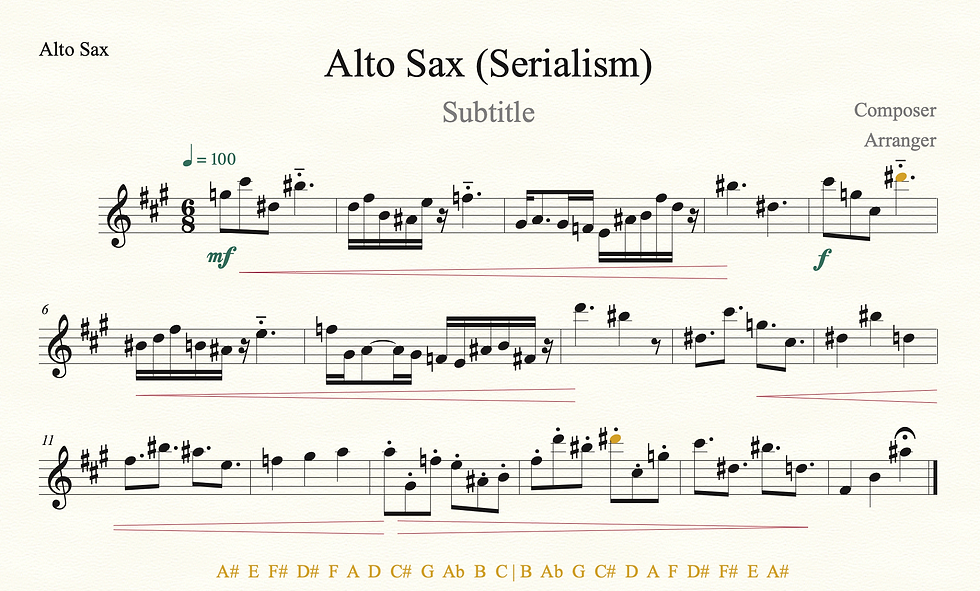
(http://www.mediafire.com/file/tmwcl6c4e21h74j/Serialism_Audio.zip/file) [If the files don't work, do not hesitate to send me an email].
NOTE: Alto Saxophone transposes its notes DOWN a major 6th (sound), hence the notes look major 6th ABOVE the 12-tone row series (9 semitones) and Clarinet in Bb transposes its notes DOWN a major 2nd (sound), while it is read a tone HIGHER (2 semitones) from the notes of the 12-tone row series (Yandell, 2018, pg. 70).
An easier way to think about is to relate the concert pitch of the instrument to the C5 note, in this case, Bb in Clarinet and Eb in the Alto Saxophone. Bb is a tone LOWER than C, hence playing C will in-turn give us a Bb note, and Eb is a major 6th LOWER than C, and thus playing C would give us an Eb note (Yandell, 2018, pg. 70).
A list of few composers who used serialism in their composition are as follows:
Arnold Schoenberg
Anton Webern
Alban Berg
Karlheinz Stockhausen
Pierre Boulez
And Bill Evans, a phenomenal Jazz composer/pianist.

(Anton von Webern, n.d.)

(Knöck, n.d.)
Brief Notes:
Arnold himself did not prefer the term Atonal and much called it Pantonal (Slatkin, Schuman, Rich, 2011, pg. 58).
*The title First Viennese School was given to a group of musicians, including Haydn, Mozart, and Beethoven, who composed music while living in Vienna (Przybylek, n.d.).
Videos:
(Cui, 2012)
(Beato, 2017)
(Farrel, 2017)
REFERENCES:
3 rules of “strict serialism” [Image]. (n.d.). Retrieved from https://www.musictheoryacademy.com/understanding-music/serialism/
Anton von Webern [Image]. (n.d.). Retrieved from http://www.classical-music.com/topic/anton-von-webern
Beato, R. (2017, Oct 10th). Introduction To Post-Tonal Theory | Schoenberg, Stravinsky, Berg [Video File]. Retrieved from https://www.youtube.com/watch?v=3OsVgdX8hm0
Cui, R. [eHow] (2012, Dec 5th). The Difference Between Tonal & Atonal Music: Piano & Music Tips [Video File]. Retrieved from https://www.youtube.com/watch?v=6qhrAEMC0ms
Factorial ! (n.d.). Retrieved from https://www.mathsisfun.com/numbers/factorial.html
Farrel, D. E. (2017, Oct 30th). Music Theory: Introduction to Twelve-Tone Serialism [Video File]. Retrieved from https://www.youtube.com/watch?v=yWeFk6bmkIA
Knöck. (n.d.). William John "Bill" Evans (August 16, 1929 – September 15, 1980) [Image]. Retrieved from https://www.pinterest.com/pin/863143084807224537/?lp=true
Musictheory.net. (2011). Tenuto (Version 4.1.2) [Mobile Application Software]. Retrieved from https://apps.apple.com/us/app/tenuto/id459313476?ign-mpt=uo%3D4
Newsom. J. (2019). Arnold Schoenberg (1874 - 1951) [Image]. Retrieved from https://pikosy.com/media/554716879104026296
Przybylek, S. (n.d.). Composers of the Second Viennese School. Retrieved from https://study.com/academy/lesson/composers-of-the-second-viennese-school.html
Serialism. (n.d.). Retrieved from https://www.musictheoryacademy.com/understanding-music/serialism/
Slatkin, L., Schuman, W., Rich, A. (2011). What To Listen For In Music. United States: Signet Classics
The Editors of Encyclopaedia Britannica. (2014). Serialism. Retrieved from https://www.britannica.com/art/serialism
Twelve-Tone Theory — Basics. (n.d.). Retrieved from http://openmusictheory.com/twelveToneBasics.html
Yandell, N. (2018). Theory of Music Workbook: For Trinity College London written exams Grade 8. England: Trinity College London Ltd
APPENDIX:
Concert Pitch. (2019). In Wikipedia. Retrieved Dec 11th, 2019, from https://en.wikipedia.org/wiki/Concert_pitch
Tone row. (2019). In Wikipedia. Retrieved Nov 21st, 2014, from https://en.wikipedia.org/wiki/Tone_row
Comments