Frequency (Low vs. High), Energy, Amplitude, and Power
- Abhishek Timbadia

- Aug 11, 2019
- 6 min read
Updated: Jan 4, 2023
In this blog we shall discuss what frequencies are and what kinds of frequencies have more energy.
What are frequencies?
Frequencies are vibrations cycles per unit time.
The SI unit of frequency is Hertz which was coined after Heinrich Rudolf Hertz (Communications System, n.d.). It means the number of cycles per second. If I say, 200 Hz, that means the wave will go up and down 200 times in one second.
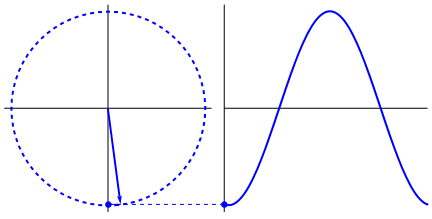
(Andy, 2019)
Another interesting statement is shown as, "so, if the time it takes for a wave to pass is 1/2 second, the frequency is 2 per second. If it takes 1/100 of an hour, the frequency is 100 per hour.” (Communications System, n.d.).
The calculations for this is as follows:
A wave is a cycle that goes up and down which we call a crest and trough. If it goes up and down once in 0.5 seconds, having our definition of Hz being cycles per SECOND, 0.5 + 0.5 = 1 second and therefore our waves goes up and down twice in one second; 2 Hz.
The second part of the statement can rather be confusing, however, it gets simple once the numbers get converted into seconds.
Taking 1/100th off an hour in seconds is 0.01 * 60 * 60 = 36 seconds.
Here, this tells us that a wave will take 36 seconds to complete given our definition of Hz.
The second statement suggests 100 per hour, which means it goes up and down a 100 times in one hour, in seconds that would be, 100/60 = 100/60 (minutes) = 1.66666667 per minute
1.66666667/60 (seconds) = 0.0277777778 per second
So, 0.0277777778 * 36 = 1 wave which can be sub-sonic or seismic waves (are earthquake waves in the Earth).
There are many types of waves i.e. light waves, sound waves, and gravitational waves etc. For this particular blog, we will be sticking to only sound waves. We will also be using the term amplitude or dB which is deciBel (coined after Alexander Graham Bell) (Gregersen, 2019). The speed of sound is 344m/s (ignoring the weather or climate) (Bassett, 2018).
What is amplitude?
Amplitude is a way of defining the loudness of waves. The maximum magnitude of displacement (going up) gets displaced equally on the other side below the equilibrium. This increase and decrease of displacement is called amplitude (SantoPietro, 2019).
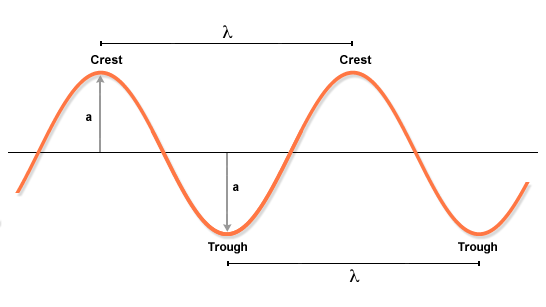
(Socratic, 2018)

(Socratic, 2018)
What is energy?
Energy in physics is the amount of work that is carried out, this may occur in kinetic energy, chemical energy, potential, thermal, or nuclear energy (Gregersen, 2019). In regards to sound, the waves are acoustic energy, in the form of kinetic and potential energy of air molecules (OpenStax, 2019). For this purpose we will talk in Power which means energy per unit time which is measured in Watts or W. This means that a 60-W light-bulb uses 60 Joules of energy per second (Prof. Hass, 2019).
The frequency hearing range chart for various species:

(Prof. Forinas, Chrisitan, and Esquembre, 2018)
As you can see, there are many animals with a wide hearing range. However, we will be considering the human hearing range from 20 Hz to 20 kHz.
High frequency vs Low frequency with formula (power)
To demonstrate what frequencies have more power/energy, we need to describe and understand how the formulas are derived.
We can derive our formula I = 2π^2ρf^2v∆s^2 (Elert, 2019). Where, I is power, π is a constant, ρ is Rho which is density, f is frequency, v is velocity (speed of sound), and the ∆ (delta) s are the amplitude. These are absorbed into the constant of proportionality.
What we want is I_1/I_2, the ratio of intensities for two sounds
Call the frequencies f_1 and f_2, and amplitude A_1 and A_2
f_1 is a variable, f_2 is a variable, A_1 is a variable, A_2 is a variable.
They represent the frequencies and amplitudes of any two tones.
We have I_1, and I_2, and now we just divide one by the other.
I_1/I_2 = (2pi^2×p×f_1^2×v×A_1^2)/(2pi^2×p×f_2^2×v×A_2^2),
The constants cancel each other out leaving us with,
I_1/I_2 = (f_1^2×A_1^2)/(f_2^2×A_2^2),
And thus, “intensity is proportional to frequency squared times amplitude squared.” (OpenStax, 2019).

(Credit: Abhishek Timbadia)
If we want the energy, we just multiply by time, I will not be demonstrating that in this example (energy is proportional to frequency squared times amplitude squared times time). We need to know that intensity is average power.
Guidelines to note on power:
If I_1/I_2 > 1, that means I_1 > I_2, since they are both positive.
If I_1/I_2 < 1, then I_1 < I_2, since again they are both positive.
If I_1/I_2 = 1, then I_1 = I_2
Or
If I_2/I_1 > 1, that means I_2 > I_1, since they are both positive.
If I_2/I_1 < 1, then I_2 < I_1, since again they are both positive.
If I_2/I_1 = 1, then I_2 = I_1 (Paul Erlich, personal communication, July 24th, 2019).
(Proportionality was a difficult sub-topic for me to understand. There will be few links below in the appendix if one wants to understand it).
If one already understands the basic concepts of proportionality, and the formula, I will demonstrate a few examples below along with some methods in calculating them. The formulas can be derived from the website in the reference list.
My first example is where 200 Hz tone is at 0dB vs 1000 Hz tone is at 0dB:
We need to convert the dB (log-amplitude) to amplitude ratio
The formula from the website would be, A_2 = A_1*10^((GaindB)/20),
However, we can make this better with algebra, A_2/A_1 = 10^((dB_2-dB_1)/20) (RapidTable, n.d.).

(Credit: Abhishek Timbadia)
The reason why GaindB is dB_2-dB_1 is because it gives us the difference to calculate the amplitude ratio (just like cents from the previous blog. More information is given in the appendix).
One can manipulate to find the dB_2-dB_1 by
10^((dB_2-dB_1)/20) = A_2/A_1
(dB_2-dB_1)/20 = log_10(A_2/A_1)
dB_2-dB_1 = 20*log_10(A_2/A_1)
0dB_2-0dB_1 = 0dB
We can then plugin the 0, A_2/A_1 = 10^((0)/20) = 1, and thus, the lesser the difference from the dB’s the closer it is to 1 amplitude ratio.
So, if the amplitude ratio is 2 then dB_2-dB_1 = 20*log_10(2) = 6.02059991dB, this means doubling in amplitude means adding 6dB (rounded to 6dB for audio engineering).
Now, in our example, the amplitudes are the same A_1 = A_2, this, we can cancel those, and the formula simplifies to,
I_2/I_1 = (f_2/f_1)^2 from I_2/I_1 =
(f_2^2×A_2^2)/(f_1^2×A_1^2).
We plug in the frequencies, I_2/I_1 = (1000/200)^2 = 25. Thus, the 1000 Hz tone has 25 times the power of the 200 Hz tone. We need to keep the formula consistent, that means, if I have my amplitude 2 in the numerator, my frequency 2 must also be in the numerator, and my intensity 2 too.
How about an another example where 200 Hz tone is -3dB vs 1000 Hz tone is -10dB:
dB_1 = -3dB
dB_2 = -10dB
f_1 = 200 Hz
f_2 = 1000 Hz
-10 - (-3) = -7
A_2/A_1 = 10^((dB_2-dB_1)/20)
10^((-7)/20) = 0.446683592
A_2/A_1 = 0.446683592
I_2/I_1 = (f_2^2×A_2^2)/(f_1^2×A_1^2) which can be written as
I_2/I_1 = (f_2/f_1)^2 * (A_2/A_1)^2
I_2/I_1 = (1000/200)^2 * (0.446683592)^2
I_2/I_1 = 4.98815578
That means 1000 Hz tone is 4.98815578 greater in power than 200 Hz tone
And thus, my conclusion states that high frequencies do have more power than low frequencies.
REFERENCES:
Andy (2015). Circular motion produces a sine wave naturally [Image]. Retrieved from https://electronics.stackexchange.com/questions/152600/why-is-sine-wave-preferred-over-other-waveforms
Bassett, M. (2018). AUD110: Principals of Sound, week 1, session 1 notes [PowerPoint slides]. Retrieved from https://moodle-dubai.axis.navitas.com/pluginfile.php/29754/mod_resource/content/4/AUD110_Wk1.pdf
Communications System. (n.d.). Retrieved from http://www.qrg.northwestern.edu/projects/vss/docs/communications/1-what-is-frequency.html
Elert, G. (2019). Intensity. Retrieved from https://physics.info/intensity/
Gregersen, E. (2019). Decibel. Retrieved from https://www.britannica.com/science/decibel
Gregersen, E. (2019). Energy. Retrieved from https://www.britannica.com/science/energy
OpenStax. (2019). Energy and Power of a Wave. Retrieved from https://phys.libretexts.org/Bookshelves/University_Physics/Book%3A_University_Physics_(OpenStax)/Map%3A_University_Physics_I_-_Mechanics%2C_Sound%2C_Oscillations%2C_and_Waves_(OpenStax)/16%3A_Waves/16.4%3A_Energy_and_Power_of_a_Wave#Power_in_Waves
Prof. Forinas, K., Christian, W., Esquembre, F. (2018). Animal Hearing [Image]. Retrieved from http://pages.iu.edu/~kforinas/S/10Perception.html
Prof. Hass, J. (2019). Chapter One: An Acoustics Primer. Retrieved from http://www.indiana.edu/~emusic/etext/acoustics/chapter1_amplitude3.shtml
RapidTables. (n.d.). What is a decibel (dB)? Retrieved from https://www.rapidtables.com/electric/decibel.html
SantoPietro, D. (n.d.). Definition of amplitude and period. Retrieved from https://www.khanacademy.org/science/ap-physics-1/simple-
harmonic-motion-ap/introduction-to-simple-harmonic-motion-ap/v/definition-of-amplitude-and-period
Socratic. (2018). What does amplitude measure? [Images]. Retrieved from https://socratic.org/questions/what-does-amplitude-measure
APPENDIX:
https://opentextbc.ca/physicstestbook2/chapter/power/
https://physics.info/energy/
https://www.plaiddogrecording.com/lesson-1
https://www.sciencelearn.org.nz/resources/120-waves-as-energy-transfer
https://www.youtube.com/watch?v=ZBd2hKuUqu4
Specifically for learning proportionality:
https://www.khanacademy.org/math/cc-seventh-grade-math/cc-7th-ratio-proportion/7th-constant-of-proportionality/v/introduction-proportional-relationships
https://www.mathsisfun.com/algebra/proportions.html
https://www.mathsisfun.com/definitions/proportional.html
Why do we subtract the decibels for amplitude ratio? If you have been reading my blogs on Microtonality this is a similar concept where dB act like cents and the amplitudes act like ratios. For example:
How do you find the ratio between F1-42c and C#5+19c?
You subtract, and then
You raise 2 to the power of the pitch difference in octaves (or cents/1200).
Well, if your pitch reference is C0, then F1-42c is +1658 (from 1700) cents, and C#5+19c is +6019 (from 6000) cents.
For the interval between them, we SUBTRACT and get 4361c
The frequency ratio is, therefore, 2^(4361/1200) = 12.416328
Or
F1-42c is +1658 cents, and C#5+19 cents is +6019c
2^(1658/1200) = 2.60569219
2^(6019/1200) = 32.3531288
32.3531288/2.60569219 = 12.416328 is 4361c
And ratio is division (subtraction).
More info:
dB is logarithmic amplitude or power, you subtract, because log(a/b) = log(a) - log(b)
Just like we don't divide cents we subtract cents.
Logarithmic units turn division into subtraction, multiplication into addition, and hence, this is just like cents.
More info:
What is the frequency ratio formed by Bb-1 and C-1? That's -200 cents and -1200 cents relative to C0. Here we subtract, (-200)-(-1200) = 1000, and calculate 2^(1000/1200) to get the frequency ratio.
Amplitude works the same way. Instead of subtracting cents, we subtract the dB.
Cents were invented so one could just add and subtract; since frequency ratios divide and multiply can be more difficult.
Similarly, dB were invented so one could just just add and subtract, since amplitude ratios divide and multiply which is more difficult.
Cents and dB are closer to how we hear. If you double amplitude or frequency over and over, it sounds like you're increasing it by about the same amount each time, so we call it a fixed amount of cents or dB.
Doubling frequency is adding 1200 cents, and doubling amplitude is adding 6dB.
Comments